How to read a protractor: inner and outer scale
To read a protractor, find the scale that shows zero on the arm you lined up with the baseline, then follow that same scale around the arc to where the other arm crosses. The number at that crossing is your angle. The tool's two rows of numbers are what make this feel harder than it is. In the 1993 National Assessment of Educational Progress, only a third of US eighth graders measured a 127 degree angle correctly, and the test allowed three degrees of grace either side. The wrong scale is the usual culprit, and this guide gives you the rule that beats it.
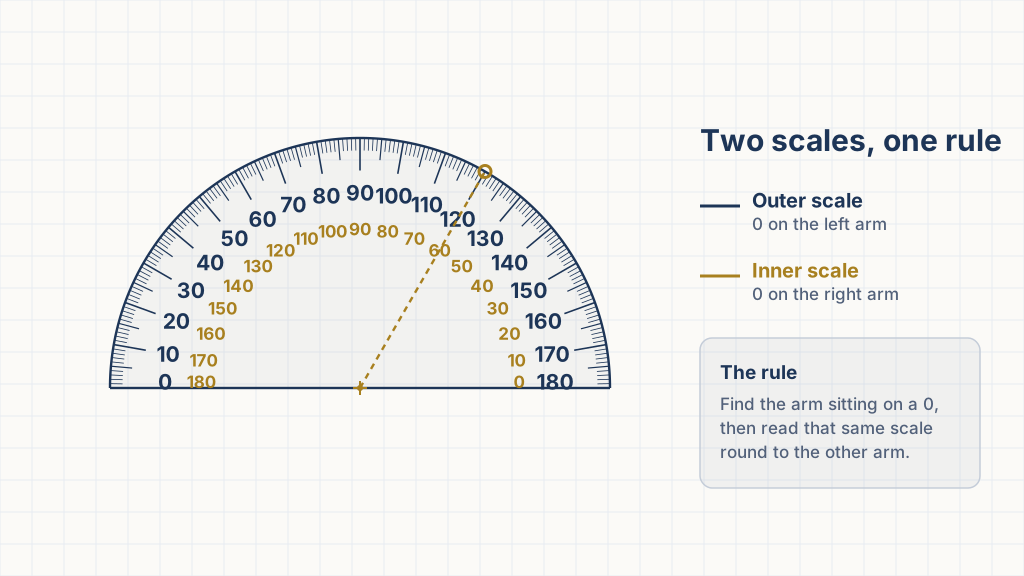
Two scales, opposite directions
Look closely at the arc of a protractor and you will see two rows of numbers. The outer scale runs clockwise from 0 up to 180, starting on the left. The inner scale runs the opposite way, counterclockwise from 0 to 180, starting on the right. They are not a mistake or decoration. They let you measure an angle that opens from the left or from the right without flipping the tool over.
A protractor "has degrees marked clockwise from 0 to 180 in the outer scale and anti-clockwise from 0 to 180 in the inner scale," and the two readings for any angle "add up to 180."
Source: Cuemath, Protractor: https://www.cuemath.com/geometry/protractor/Between the numbered marks sits the fine print. Standard school protractors label the scales every 10 degrees, add a longer tick at each 5, and mark single degrees in between. The smallest step is 1 degree, which is why the fourth grade Common Core standard (4.MD.C.6) asks students to measure angles "in whole-number degrees using a protractor." If an arm lands between two ticks, calling it to the nearest half degree is as precise as the tool honestly gets.
Which scale do you read on a protractor?
Read the scale whose zero sits on the arm you lined the baseline up with, and stay on that scale all the way to the second arm. That is the whole rule. Reference arm on the outer zero: the answer is the outer number. Reference arm on the inner zero: read the inner number.
The two scales exist so that one of them always starts at zero on your arm, whichever way the angle opens. Pick that one and ignore the other. If neither scale shows zero at your first arm, the protractor is placed wrong. Recentre it so the crosshair sits on the vertex and the baseline lies along the arm, which is covered step by step in how to use a protractor.
The 127 degree test
Here is the trap in action. Draw a wide, open angle of 127 degrees and measure it. The second arm crosses the arc at a point where one scale says 127 and the other says 53. Both numbers sit right there under the same arm, printed with equal confidence. Pick the scale that started at zero on your baseline arm and you get 127. Grab the other one and you walk away with 53, off by 74 degrees with no warning.
"The National Assessment of Educational Progress in the United States in 1993 reported that only one third of eighth graders using conventional protractors could successfully measure a 127 degree angle, and that was with an allowance of three degrees on either side of 127 degrees."
Source: US Patent 5,588,218, Teaching protractor (Barry, 1996), citing the 1993 NAEP: https://patents.google.com/patent/US5588218AThat result stings because the skill is taught in fourth grade. The gap is not arithmetic. It is scale choice, and the estimate-first habit below closes it.
Why do the two numbers add up to 180?
The two readings under the second arm always sum to 180 because the scales run in opposite directions along the same half circle. Any line crossing the arc splits that 180 into two pieces: one scale reports the piece measured from the left end, the other reports the piece measured from the right. So 127 pairs with 53, and 60 pairs with 120.
Two angles that sum to 180 are called supplementary, and the pair you see on the arc is exactly the pair the angle's arm makes with the two halves of a straight line. Our guide to types of angles covers supplementary and complementary pairs with the notation for each. On the protractor itself, the takeaway is shorter: the second number is not a second opinion. It is the leftover.
Estimate first, then measure
Before you read any number, decide what neighborhood the answer lives in. Compare the angle to the corner of a sheet of paper, which is 90 degrees. Narrower than the corner means acute, under 90. Wider means obtuse, over 90. Half the corner is 45, and 135 splits the difference between a right angle and a straight line.
Now the scales can't fool you. If the angle is clearly wider than a paper corner and one candidate reading is 53, then 53 is wrong and 127 is your answer. This two-second habit is the single best defense against the wrong-scale error, and it costs nothing. Teachers drill it for a reason: an estimate turns a silent mistake into an obvious one.
Reading between the numbered marks
Once you know which scale to trust, the last step is the ticks. Find the labeled number your arm has passed, then count single-degree marks toward the next label in the direction your scale increases. An arm two ticks past the 60 label, heading toward 70, reads 62. Count the wrong way and you get 58, a quiet four degree error.
Direction matters here for the same reason the scales confuse people: on the inner scale, "increasing" runs the opposite way to the outer. Say the count out loud if it helps, 61, 62, done. On a printout, crisp ticks make this easier, so print at 100 percent scale and check the calibration bar first. Our guide on printing a protractor to scale shows the settings.
How do you read an angle bigger than 180 degrees?
A semicircular protractor only shows 0 to 180, so for a reflex angle you measure the small angle and subtract from 360. Measure the gap the angle leaves, then do the arithmetic. If the non-reflex side reads 50 degrees, the reflex angle is 360 minus 50, which is 310.
The other route is to skip the subtraction. A full-circle protractor reads reflex angles directly, and the printable protractor generator can produce a 360 degree version at whatever radius you need. It also lets you switch the double scale off entirely, which leaves one clean row of numbers and removes the wrong-scale trap for good. Drawing a reflex angle instead of measuring one uses the same subtraction trick, covered in how to draw an angle.