What are vertical angles?
Vertical angles are the two angles facing each other where two straight lines cross. They share the same corner point but no side, and they are always equal. Every crossing makes two pairs of them. If one angle at an X measures 40 degrees, the angle straight across from it is 40 too, and the other two angles are 140 each.
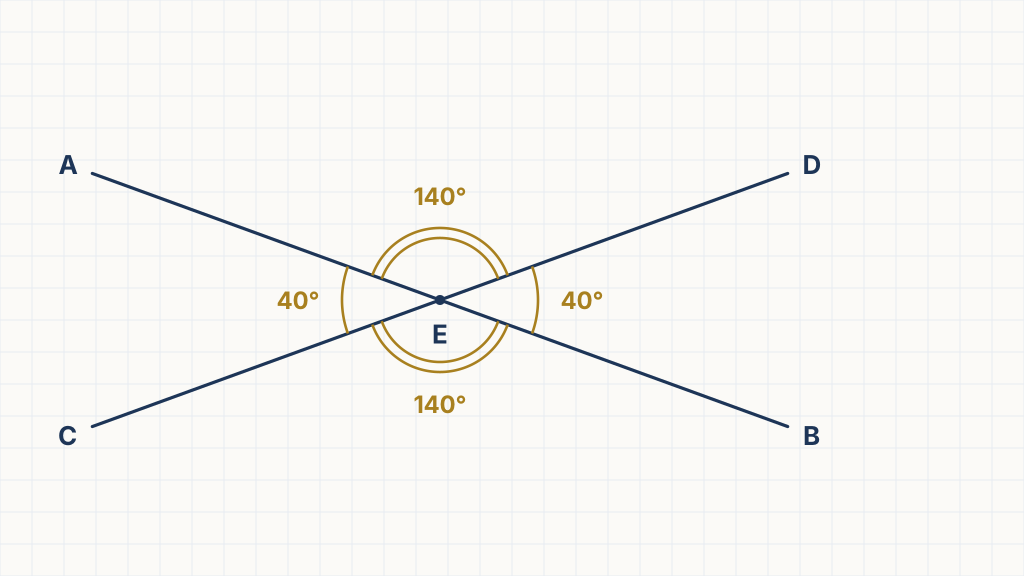
This is one of the oldest results in geometry. Euclid put it in the Elements as Book I, Proposition 15. The Greek commentator Proclus, writing more than 700 years later, passed on a claim from Eudemus of Rhodes that Thales of Miletus had found the fact first, in the sixth century BC, and that Euclid was the one who gave it a proper proof.
"If two straight lines cut one another, then they make the vertical angles equal to one another."
Source: Euclid, Elements, Book I, Proposition 15, D.E. Joyce edition, Clark University: https://mathcs.clarku.edu/~djoyce/java/elements/bookI/propI15.htmlToday it's grade 7 material. Common Core standard 7.G.B.5 asks students to use facts about supplementary, complementary, vertical and adjacent angles to write and solve equations for an unknown angle.
Why are they called vertical angles?
Because they share a vertex, not because they point up and down. The word vertical comes from the Latin vertex, and in English it first meant "at the vertex" or "directly overhead". The up-and-down meaning isn't recorded until 1704, according to the Online Etymology Dictionary. UK schools avoid the confusion by calling them vertically opposite angles.
That name trips people up for a good reason. Draw two lines crossing like a flattened X, with the pair of narrow angles opening to the left and right, and the "vertical" angles are lying on their sides. Turn the paper 90 degrees and nothing about them changes. The name is about where the angles sit relative to the corner point, and orientation on the page has nothing to do with it.
Why are vertical angles always equal?
Because each one adds to the same neighbour to make a straight line. Angles along a straight line total 180 degrees. So both angles in a vertical pair equal 180 minus the angle between them. Two things that equal the same amount equal each other. That's the whole proof, and it works for any crossing.
Here it is with letters, which is how Euclid set it out. Line AB and line CD cross at point E.
- Angle AEC and angle CEB sit side by side along line AB, so they add to 180 degrees.
- Angle CEB and angle BED sit side by side along line CD, so they also add to 180 degrees.
- Both sums contain angle CEB. Take it away from each and what is left must match.
- So angle AEC equals angle BED. The same steps with angle AED in the middle show that angle CEB equals angle AED.
Nothing in those four steps depends on how steep the lines are. A shallow 12 degree crossing and a near-square 88 degree one follow the same rule. The Elements follows it with a corollary, possibly added by a later editor: the four angles at the crossing total four right angles, which is 360 degrees.
How do you find a missing vertical angle?
Look straight across the crossing. The angle opposite the unknown one has the same measure, so copy it over. If you're given a neighbouring angle instead, subtract it from 180. With one angle known, you can fill in all four: two copies of it, and two copies of 180 minus it.
Say one angle at an intersection is 63 degrees. The opposite angle is 63. The two neighbours are 180 minus 63, which is 117 each. Check the total: 63 plus 63 plus 117 plus 117 is 360. Good.
Algebra problems use the same two facts, and the only question is which one applies. Pick by where the angles sit.
- Opposite each other: set the expressions equal. If one angle is 3x + 10 and the angle across from it is 5x - 30, then 3x + 10 = 5x - 30, so 40 = 2x and x = 20. Both angles are 70 degrees, and the other pair is 110.
- Side by side on one line: add them to 180. If the angles are 2x and x + 30, then 3x + 30 = 180, so x = 50. The angles are 100 and 80, and the ones opposite them are 100 and 80 too.
The easy slip is using the wrong equation, so decide "opposite or side by side" before writing anything. In UK exams, write the reason as well. The Pearson Edexcel International GCSE mark scheme from November 2020 lists "vertically opposite angles are equal" among the reasons that earn a method mark, so the full phrase is worth writing out.
Are vertical angles adjacent or supplementary?
Never adjacent, and supplementary only in one case. Adjacent angles share a side, and vertical angles share only the corner point. They add to 180 only when each is 90 degrees, which happens when the two lines are perpendicular. At any other crossing, the vertical pair is either both acute or both obtuse.
The pair that is supplementary every time is the neighbours. Two angles sitting side by side along a straight line are called a linear pair, and they always total 180. So each crossing gives you two vertical pairs (equal) and four linear pairs (adding to 180). Keep those apart and most angle diagrams solve themselves without a protractor. The full set of names is in our guide to types of angles.
You've already seen a linear pair if you've used a protractor. The two numbers printed under an arm, like 127 on one scale and 53 on the other, always add to 180. They are the angle and its neighbour along the baseline, which is why reading the inner and outer scale comes down to picking the right one.
How to spot vertical angles in a busy diagram
Vertical angles need two straight lines that pass right through the corner point. Two angles that only look opposite don't qualify, and this is where most mistakes happen.
- Check both lines run straight through. If one "line" bends at the corner, you have three or four separate rays, and the angles across from each other can be any size.
- A ray that stops at the corner doesn't count. A T junction has a linear pair on each side of the stem and no vertical pair.
- With more lines through one point, pair them carefully. Three lines through a point make six angles and three vertical pairs. An angle's partner is the one directly across, with the same number of angles on either side between them.
- Don't read size off the drawing. Unless a figure says it's drawn to scale, a 70 degree angle can be sketched looking like 50.
- In parallel line diagrams, each crossing has its own two vertical pairs. Angles in the same position at different crossings are corresponding angles, which is a separate rule.
Where vertical angles show up outside a textbook
Anything shaped like an X with straight arms. The legs of a folding X-frame sawhorse or camp stool cross at a bolt, so the opening at the top matches the opening at the floor. Set the top to 50 degrees and the feet spread at 50 too. A cross brace on a gate or fence panel does the same thing: measure the angle above the crossing and you know the one below it without moving the tool.
Road and rail crossings are another case. Two straight roads meeting at a skew make two sharp corners and two wide corners, and the sharp ones sit diagonally across from each other at the same angle. If a kerb or a signpost blocks one corner, measure the corner diagonally across from it instead.
Use vertical angles to check your protractor reading
Measure all four angles at a crossing and compare. The opposite pairs should match, each neighbouring pair should add to 180, and the four should total 360. If the two readings in a vertical pair differ by more than a degree, the protractor was placed wrong on one of them. Recentre it and read again.
That check is worth doing because a protractor can't split a degree finely. On a protractor with a 50 mm radius, one degree along the arc is only 0.87 mm wide, so half a degree is about the best you can read by eye. A 100 mm radius doubles that spacing to 1.75 mm. If you print your own with the protractor tool, use the largest radius the page holds, draw the lines long enough to reach past the scale, and measure both angles in the pair. When the two numbers agree, you can trust them.
A drawn X also makes a quick test for a new printout. Rule two long lines crossing near the middle of a sheet, measure one angle, then measure the one across from it. Matching readings mean your placement is sound. For the other things that cost degrees, see protractor accuracy.
Sources: Euclid, Elements, Book I, Proposition 15 and its corollary, in D.E. Joyce's online edition (Clark University). The Thales attribution is Proclus, Commentary on the First Book of Euclid's Elements, citing Eudemus of Rhodes, as quoted at cut-the-knot.org (Thales' Theorems). Grade placement from Common Core State Standards for Mathematics, 7.G.B.5. Etymology of vertical from the Online Etymology Dictionary. Exam reason wording from the Pearson Edexcel International GCSE Mathematics A mark scheme, Paper 2, November 2020. Arc spacing (0.87 mm per degree at 50 mm radius) is 2 x pi x 50 / 360.