What is a supplementary angle?
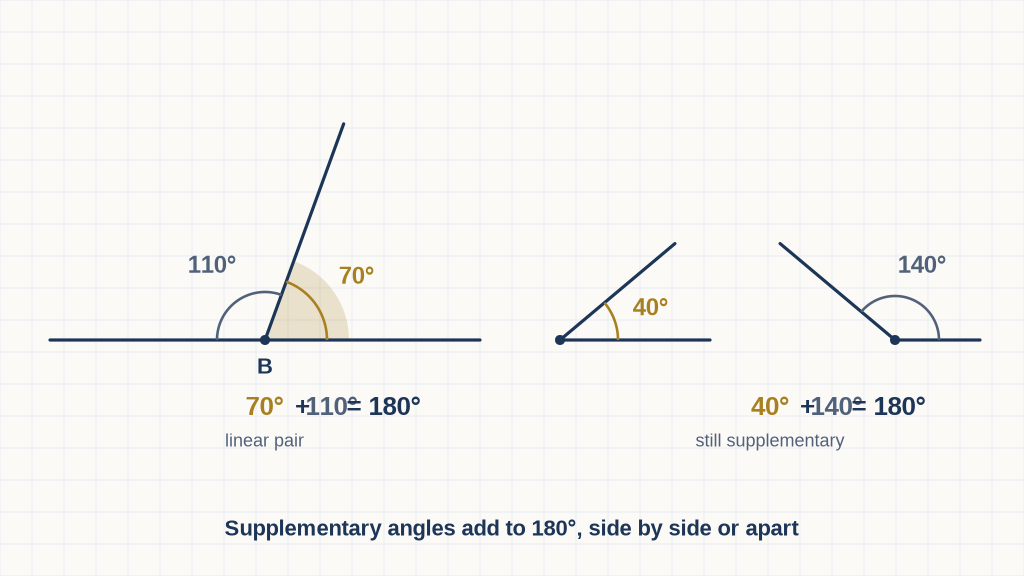
A supplementary angle is one of two angles that add up to 180 degrees, the size of a straight line. Each angle is the supplement of the other, so to find one you subtract from 180: the supplement of 70 degrees is 110, and the supplement of 25 is 155. The two angles can sit side by side or be drawn far apart. Only the total counts.
In US schools this is grade 7 work. Common Core standard 7.G.B.5 asks students to use facts about supplementary, complementary, vertical and adjacent angles to write and solve equations for an unknown angle. It still trips people up years later. In the 2005 National Assessment of Educational Progress, twelfth graders were shown a cross street meeting Main Street at 70 degrees and asked for the angle it makes with a planned Elm Street running parallel to Main. The answer was 110. Only 73 percent of seniors got it right, and among students below the Basic level it was 49 percent. Choice A on that question was 70, the number already on the map.
The idea is far older than degrees. Euclid's Elements, Book I, Proposition 13, says that a straight line standing on another straight line makes either two right angles or two angles that together equal two right angles. Euclid never measured in degrees, so "two right angles" is his way of writing 180.
How do you find the supplement of an angle?
Subtract the angle from 180 degrees. The supplement of 65 degrees is 180 minus 65, which is 115. The supplement of 128.5 degrees is 51.5. Only an angle between 0 and 180 has a supplement in the usual sense, because an angle of 180 or more has already used up the whole straight line.
A few to check yourself against:
- 30 degrees has a supplement of 150
- 90 degrees has a supplement of 90
- 120 degrees has a supplement of 60
- 179 degrees has a supplement of 1
Angles in degrees and minutes need one extra step. Write 180 degrees as 179 degrees 60 minutes, then subtract. So the supplement of 47 degrees 25 minutes is 132 degrees 35 minutes. In radians a straight line is pi, which makes the supplement of an angle x equal to pi minus x. The supplement of pi/3 is 2pi/3.
Every protractor is a table of supplements
Look at any tick on a protractor with two rows of numbers. The outer and inner numbers at that tick always add to 180: 70 sits with 110, 40 with 140, 15 with 165. When an arm crosses the arc, it makes one angle with each half of the baseline, and those two angles together fill a straight line. The pair printed on the scale is a supplementary pair.
That's also why the most common protractor mistake gives such a tidy wrong answer. Read the wrong row and the number you get is the supplement. A 35 degree corner read off the wrong scale comes out as 145. The rule that prevents it is in our guide to reading the inner and outer scale: use the row that starts at zero on the arm you lined up with the baseline, then compare the answer with a square corner. Sharper than a corner means under 90.
To practise, open the printable protractor tool and leave Double scale switched on, which numbers the arc both ways, 0 to 180 and 180 to 0. Print at 100 percent and measure the calibration bar before you trust a reading.
Do supplementary angles have to be adjacent?
No. Supplementary describes the total and nothing else. Two angles that add to 180 are supplementary whether they share a side or sit at opposite ends of the page. When they are adjacent and their outer arms form one straight line, they also get a second name: a linear pair.
Every linear pair is supplementary. The reverse doesn't hold. A 40 degree angle in one corner of the page and a 140 degree angle in the other are supplementary, but they aren't a linear pair, because they don't touch. US geometry courses usually call the first fact the linear pair postulate. Euclid treated it as something to prove, in that Proposition 13.
Can two acute angles be supplementary?
No. Two angles that are each under 90 degrees add up to less than 180, and two obtuse angles add up to more. So a supplementary pair is always one acute angle with one obtuse angle, or two right angles. If both your answers are under 90, or both are over, one of them is wrong.
Supplementary vs complementary angles
Complementary angles add to 90 degrees, the size of a square corner. Supplementary angles add to 180, a straight line. One way to keep them apart is S for straight and C for corner.
For any angle under 90, the supplement is exactly 90 more than the complement. Take 40 degrees. Its complement is 50 and its supplement is 140. That fixed gap is behind a classic exam question: the supplement of an angle is three times its complement, so find the angle.
Write the supplement as 180 - x and the complement as 90 - x. Then 180 - x = 3(90 - x). Expand the bracket to get 180 - x = 270 - 3x, which gives 2x = 90, so x = 45. Check it: the supplement of 45 is 135, the complement is 45, and 135 is three times 45.
There's one more difference. Only an acute angle has a complement, since an angle of 90 or more leaves nothing to add. Every angle under 180 has a supplement, obtuse ones included.
How do you solve for x with supplementary angles?
Add the two expressions, set the total equal to 180, and solve for x. Then put x back in to get each angle, and check that the two add to 180. The method is the same whether the angles are written as expressions like 3x + 20, given as a ratio, or described in words.
- Two angles on a straight line are 3x + 20 and 2x + 10. Then 5x + 30 = 180, so 5x = 150 and x = 30. The angles are 110 and 70.
- Two supplementary angles are in the ratio 2 to 3. Call them 2k and 3k. Then 5k = 180, so k = 36, and the angles are 72 and 108.
- One angle is four times its supplement. Then x + 4x = 180, so x = 36. The angles are 36 and 144.
Plug the answer back in every time. In the first example, 3 times 30 plus 20 is 110, 2 times 30 plus 10 is 70, and 110 plus 70 is 180. If the check fails, go back through the algebra.
Where supplementary pairs hide in a figure
Most angle problems lean on a handful of standard pairs. Spot one and the 180 rule does the rest.
- Angles on a straight line. Any two neighbours along one line add to 180, which is Euclid's Proposition 13. Where two lines cross, there are four of these pairs, alongside the two pairs of equal vertical angles.
- Co-interior angles. Where one line crosses two parallel lines, the two angles between the parallels on the same side add to 180 (Euclid I.29). The NAEP street question rests on parallel-line facts like this: the 70 degree angle at Main Street pairs with a 110 degree angle at Elm Street. The equal pairs in the same figure are covered in what are corresponding angles.
- Side-by-side corners of a parallelogram. Any two neighbouring corners add to 180, so a parallelogram with one 65 degree corner has corners of 65, 115, 65 and 115.
- Opposite corners of a quadrilateral with all four corners on a circle. Euclid proves they add to 180 in Book III, Proposition 22. If one corner is 80 degrees, the corner across from it is 100.
- An exterior angle and the interior angle beside it. Extend one side of a triangle past a corner, and the outside angle is the supplement of the inside one. Euclid I.32 adds that it also equals the two far corners added together. In a triangle with corners of 50, 60 and 70, the exterior angle at the 70 degree corner is 110, which is 50 plus 60.
In UK exams the fact is usually written out as a reason rather than named in one word. Pearson Edexcel's mark scheme for its June 2012 GCSE Higher paper 5MB2H/01 gives the communication mark for reasons worded as "angles on a straight line add up to 180" and "allied (or co-interior) angles add up to 180". The word supplementary doesn't appear anywhere in it. So in a UK exam, write the full sentence.
Use supplements to draw a regular polygon with a protractor
Supplementary angles are how you draw a regular pentagon, hexagon or octagon by hand. At each corner of a polygon, the inside angle and the outside turn (the angle between one side and the next side extended) form a linear pair. The outside turns of any convex polygon add to 360 degrees, a corollary that Proclus attached to Euclid's I.32. So in a regular polygon with n sides, each outside turn is 360 divided by n, and each inside angle is its supplement.
| Shape | Sides | Outside turn | Inside angle |
|---|---|---|---|
| Equilateral triangle | 3 | 120 | 60 |
| Square | 4 | 90 | 90 |
| Regular pentagon | 5 | 72 | 108 |
| Regular hexagon | 6 | 60 | 120 |
| Regular octagon | 8 | 45 | 135 |
To draw a pentagon with 50 mm sides:
- Draw a 50 mm line. This is the first side.
- Put the protractor's centre on the right-hand end, with the baseline along the side you drew.
- On the scale that reads zero over that side, mark 108 degrees, on the side where the shape will be. Draw a 50 mm line from the end through your mark.
- Repeat at each new end, always measuring from the side you've just drawn.
- The fifth side should finish on your starting point.
If the shape doesn't close, a reading was off. Mark every corner at 107 instead of 108 and the turns add to 365, not 360, so with 50 mm sides the last line misses the start by about 3.7 mm. A larger protractor makes each degree easier to hit. At 190 mm across, close to the biggest half-circle that fits on A4 or Letter in the tool, one degree is 1.66 mm along the arc, against 1.31 mm on the default 150 mm size. For marking each ray cleanly, follow how to draw an angle with a protractor.
Sources: Euclid, Elements, Book I, Propositions 13, 29 and 32 and Book III, Proposition 22, in D.E. Joyce's online edition (Clark University), including the corollary of Proclus on exterior angles given on the I.32 page. Grade placement from Common Core State Standards for Mathematics, 7.G.B.5 (and 4.MD.C.7, where angle measure is first treated as additive). The street question and its results (73 percent correct overall, 49 percent below Basic) from the 2005 NAEP Mathematics grade 12 sample questions, National Center for Education Statistics. Exam reason wording from the Pearson Edexcel June 2012 GCSE Mathematics (2MB01) Higher mark scheme, paper 5MB2H/01, question 1. The 3.7 mm closing gap is the sum of five 50 mm sides each turned 73 degrees. Arc spacing is pi x diameter / 360.