What are corresponding angles?
Corresponding angles are the two angles that sit in the same position at two different crossings, where one line (the transversal) cuts across two other lines. When those two lines are parallel, corresponding angles are equal. A transversal through two lines makes eight angles and four corresponding pairs, so if the top-right angle at one crossing is 65 degrees, the top-right angle at the other crossing is 65 too.
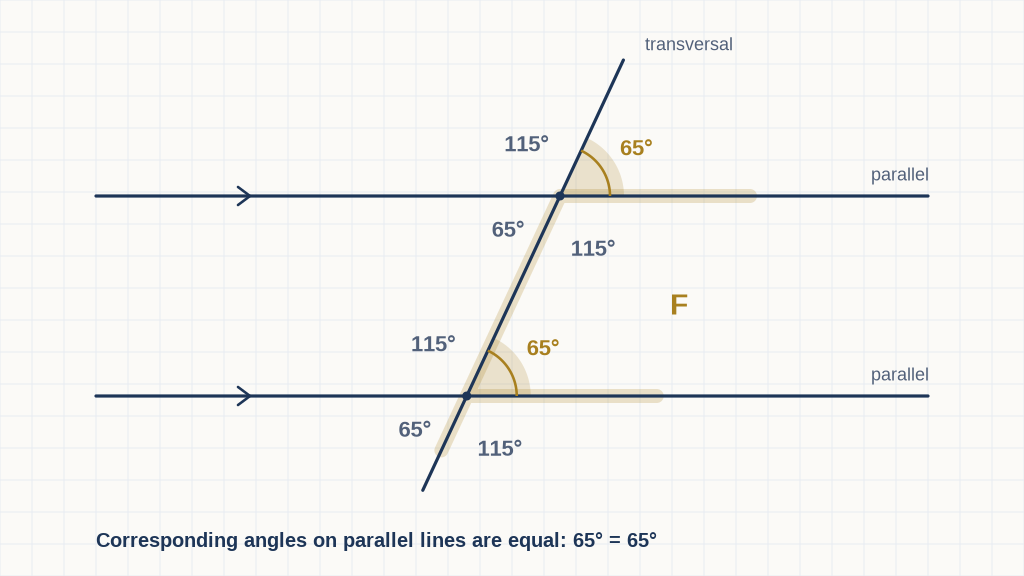
The rule is more than 2,000 years old. Euclid's Elements states it in Book I, Proposition 29: a straight line falling on parallel lines makes the exterior angle equal to the interior and opposite angle. That exterior and interior pair is what we now call corresponding angles. Proposition 29 is also the first in the Elements that needs the parallel postulate, so this fact rests on what "parallel" means. In US schools, Common Core standard 8.G.A.5 brings it in during grade 8, and the high school standard G-CO.C.9 asks students to prove it.
How do you find corresponding angles?
Pick one crossing and name the angle's position: above or below the line, left or right of the transversal. Then go to the other crossing and take the angle in the same spot. Top-right goes with top-right, bottom-left with bottom-left. One angle of the pair sits between the two lines and the other sits outside them, both on the same side of the transversal.
Each crossing has four angles, so there are four corresponding pairs in all:
- top-left at the first crossing with top-left at the second
- top-right with top-right
- bottom-left with bottom-left
- bottom-right with bottom-right
Trace the pair with your finger and you draw a capital F, which is why UK students learn them as F angles. The F can be backwards, upside down, or both. Don't write "F angles" in an exam answer, though. In its November 2007 examiner report, Pearson Edexcel told International GCSE candidates to write "corresponding angles" and said "F angles" was no longer accepted as a reason. The same report turned down "Z angles" for alternate angles.
Are corresponding angles always equal?
No. They're equal only when the two lines the transversal crosses are parallel. You can still name corresponding angles on any two lines, but if the lines tilt toward each other the pair won't match. The gap between them is exactly the angle at which the two lines would meet if you extended them.
Here's why. Extend the two lines until they meet, and you get a triangle with the transversal as its third side. One angle of the corresponding pair sits inside that triangle. The other is outside it, and an exterior angle of a triangle equals the two far interior angles added together. So if the lines meet at 10 degrees, and the inside angle is 70, the outside one is 80.
That's also the reason a slightly off drawing gives slightly off answers. Two lines that look parallel but lean 2 degrees toward each other give corresponding angles 2 degrees apart.
How do you find a missing corresponding angle?
Copy it across. If the lines are parallel, the angle in the same position at the other crossing has the same measure. From one known angle you can fill in all eight: four angles of that size and four of 180 minus it, because the angles beside each other along a straight line add to 180.
Say the top-right angle at the upper crossing is 65 degrees. Then:
- The top-right angle at the lower crossing is 65 (corresponding angles).
- The top-left angle at each crossing is 180 minus 65, which is 115 (angles on a straight line).
- The bottom-left angle at each crossing is 65, straight across from the top-right one. Those are vertical angles, and they're equal at every crossing.
- The bottom-right angle at each crossing is 115.
Check the sum at either crossing: 65 plus 115 plus 65 plus 115 is 360.
Algebra questions use the same idea. If a pair of corresponding angles is labelled 4x + 12 and 6x - 20, set them equal: 4x + 12 = 6x - 20. Move things across to get 32 = 2x, so x = 16. Both angles are 76 degrees. Plug 16 back in to check, since 4 times 16 plus 12 and 6 times 16 minus 20 both come to 76. The other four angles in the figure are 104.
Corresponding, alternate and co-interior angles
Parallel line diagrams have three named pairs, and they're easy to mix up. Edexcel's examiners flagged it in that same 2007 report, noting that scripts often confused alternate and corresponding angles. Sort them by where the two angles sit.
- Corresponding angles are on the same side of the transversal, one between the lines and one outside. They're equal. The shape is an F.
- Alternate interior angles are on opposite sides of the transversal, both between the lines. They're equal too. The shape is a Z.
- Co-interior angles (also called same-side interior or allied angles) are on the same side, both between the lines. They add to 180. The shape is a C or U.
In the 65 degree figure above, the top-right angle at the upper crossing and the bottom-left angle at the lower crossing aren't in the same position, but they're still equal. They're alternate exterior angles, a pair some textbooks add as a fourth type. When you're unsure which name applies, find the position of each angle first. The name follows from that.
Use corresponding angles to test for parallel lines
The rule also runs backward. If a transversal makes a pair of corresponding angles equal, the two lines it crosses are parallel. Euclid proves this converse first, as Proposition 28, before he proves the rule itself.
That gives you a way to check lines on paper. Draw a straight line across both of them, measure the angle in one position at each crossing, and compare. Equal readings mean parallel. A difference means the lines lean toward each other by that many degrees. To read the angle, put the protractor's centre point on the crossing and its baseline along the line you're testing, the same placement you'd use for any angle.
The same check works off the page. Lay a straightedge across two shelves, or two ruled lines on a poster you're hanging, and measure where it meets each one. If the angles differ, so do the slopes.
Draw a parallel line with a protractor
Corresponding angles are how you draw a line parallel to another through a chosen point, with nothing but a ruler and a protractor.
- Draw your first line, and mark the point P where the new line needs to pass.
- Draw a straight line through P that crosses the first line. This is the transversal.
- Measure the angle where the transversal meets the first line. Note which position it's in, for example top-right.
- Move the protractor to P, with its centre on P and its baseline along the transversal. Mark the same angle in the same position.
- Draw through P and your mark. The new line is parallel to the first one.
A small error grows with length. A line that's off by 1 degree drifts about 1.7 mm from true over 100 mm, and about 3.5 mm over 200 mm. So use a long transversal and a large protractor. On a protractor with a 100 mm radius, each degree is 1.75 mm apart along the arc, double the spacing of a 50 mm one. You can set that size in the printable protractor tool and check it against the calibration bar before you start. The steps for marking a ray cleanly are in how to draw an angle with a protractor.
Drafters used the same idea before CAD. Sliding a set square along a fixed straightedge keeps the angle between them constant, so every line drawn against the square's edge makes the same corresponding angle with the straightedge. All of those lines come out parallel.
Where corresponding angles show up
Angled parking bays are a good example. Each painted stripe leaves the kerb line at the same angle, often 45 or 60 degrees, and that's what keeps the stripes parallel down the whole row. Stair balusters work the same way: they all stand vertical, so each one meets the sloping handrail at the same angle. If one baluster meets the rail at a different angle from the rest, it's out of plumb.
Sources: Euclid, Elements, Book I, Propositions 28 and 29, in D.E. Joyce's online edition (Clark University), including the note that I.29 is the first proposition to use the parallel postulate. Grade placement from Common Core State Standards for Mathematics, 8.G.A.5 and HSG-CO.C.9. Exam wording from the Pearson Edexcel International GCSE Mathematics (4400) examiner report, November 2007. Drift figures are tan(1 degree) x 100 mm and x 200 mm. Arc spacing (1.75 mm per degree at 100 mm radius) is 2 x pi x 100 / 360.