How to convert an angle in degrees to radians
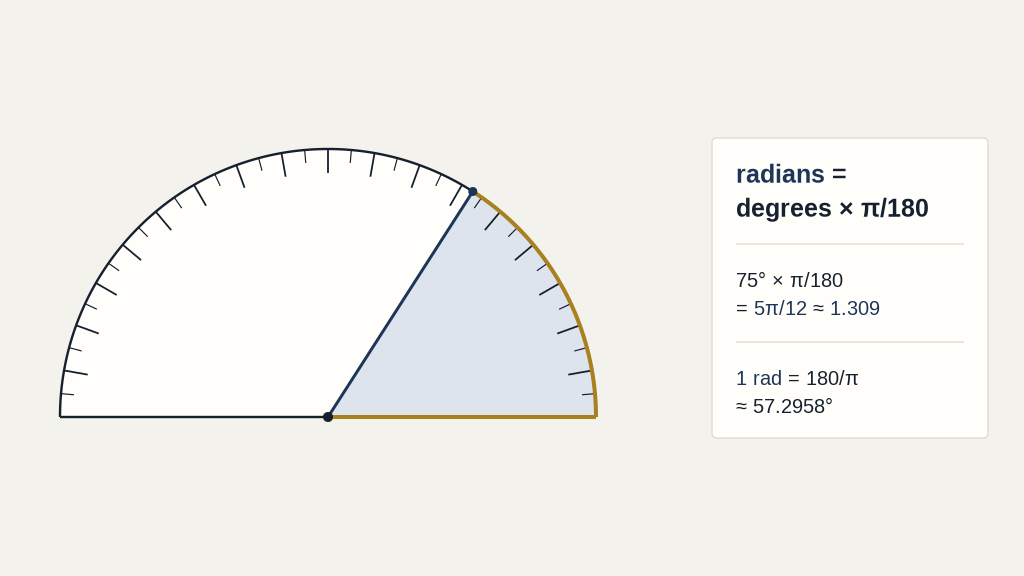
To convert an angle in degrees to radians, multiply it by π/180. So 90 degrees is 90 × π/180 = π/2, which is about 1.5708 radians, and 45 degrees is π/4, about 0.7854. For a decimal answer in one step, multiply by 0.0174533. The factor comes from a single fact: a full turn is 360 degrees and also 2π radians, so 180 degrees is the same angle as π radians.
That factor is exact. The US National Institute of Standards and Technology lists the degree in its Guide to the SI (Special Publication 811) as a unit accepted for use with the SI, defined as exactly π/180 radian. The radian is the SI unit of plane angle itself. Degrees are what you read off a protractor. Radians are what calculus, physics and most programming languages expect, and in US high schools Common Core standard HSF-TF.A.1 asks students to understand radian measure as the length of the arc an angle cuts off on the unit circle.
The number is older than it looks. In 1722 Robert Smith published Harmonia mensurarum, the collected work of his late cousin Roger Cotes. In his editor's notes he printed 57.2957795130 degrees for the angle whose arc equals the radius, along with its reciprocal, 0.0174532925. That's the conversion factor you'd type into a calculator today, printed more than 300 years ago.
How do you convert degrees to radians step by step?
Write the angle as a fraction over 180, simplify it, then put π on top. That gives the exact answer a textbook wants. For a decimal, work the exact answer out, or multiply the degrees by 0.0174533 directly. Both routes land on the same number: 75 degrees is 5π/12 exactly, or 1.3090 radians to four decimal places.
Here's 75 degrees worked through:
- Write it as a fraction of 180: 75/180.
- Simplify. Both numbers divide by 15, so 75/180 = 5/12.
- Put π on top: 5π/12.
- For a decimal, 5 × 3.14159 ÷ 12 = 1.3090.
Three more to check yourself against:
- 210 degrees: 210/180 = 7/6, so 7π/6, about 3.6652 radians.
- 37.5 degrees: 37.5/180 = 5/24, so 5π/24, about 0.6545 radians.
- Minus 45 degrees: the sign comes along, so -π/4, about -0.7854 radians.
A rough check catches most slips. One radian is a little over 57 degrees, so dividing the degrees by 60 gives an answer slightly under the right one. 75 divided by 60 is 1.25, and the real answer, 1.309, is a bit higher. If your answer is about 3,300 times too big, you multiplied by 180/π instead of π/180.
Degrees, minutes and seconds
Turn the minutes and seconds into a decimal degree first, then convert. 47 degrees 25 minutes is 47 + 25/60 = 47.4167 degrees, which is 0.8276 radians. NIST's guide gives the smaller units exact values too: one minute of arc is π/10 800 radian and one second is π/648 000. It also recommends writing angles in decimal degrees, 22.20 rather than 22 degrees 12 minutes, except in fields like cartography and astronomy.
Degrees to radians chart
These are the angles you'll meet most often.
| Degrees | Radians (exact) | Radians (decimal) |
|---|---|---|
| 0 | 0 | 0 |
| 15 | π/12 | 0.2618 |
| 30 | π/6 | 0.5236 |
| 45 | π/4 | 0.7854 |
| 60 | π/3 | 1.0472 |
| 90 | π/2 | 1.5708 |
| 120 | 2π/3 | 2.0944 |
| 135 | 3π/4 | 2.3562 |
| 150 | 5π/6 | 2.6180 |
| 180 | π | 3.1416 |
| 270 | 3π/2 | 4.7124 |
| 360 | 2π | 6.2832 |
You don't need to memorise all of it. Learn that 30 degrees is π/6, 45 is π/4 and 60 is π/3, and the rest are multiples. 150 is five 30s, so it's 5π/6. 135 is three 45s, so it's 3π/4. Where these angles turn up in real objects, like the 120 degree corners of a hex nut, is in our guide to common angles.
What is a radian?
A radian is the angle you get when the arc along a circle's edge is exactly as long as its radius. Lay one radius-length along the curve, join both ends to the centre, and the angle there is one radian: about 57.2958 degrees, or 57 degrees 17 minutes 45 seconds. The size of the circle doesn't change it.
That definition is where the 2π comes from. A circle's circumference is 2π times its radius, so 2π radius-lengths fit around it: six whole ones and a leftover 0.2832. A full turn is 2π radians, about 6.2832, and a half turn is π.
Because a radian is one length divided by another, the units cancel. NIST calls the radian a special name for the number one, and in practice the word is often left off. If a problem gives an angle as 2, with no degree sign, it means 2 radians. That catches people out. Hatice Akkoç of Marmara University, who studies how radians are taught, reports that students tend to reject an angle as radians when it has no π in it. But 2 radians is an ordinary obtuse angle of about 114.6 degrees.
See one radian on a printed protractor
You can check the definition with a printout and a strip of paper.
- Open the printable protractor generator, choose 360 (full) and leave the size at 150 mm diameter. That makes the radius 75 mm.
- Print at 100 percent and measure the 100 mm calibration bar. If it reads 100 mm, the radius on paper is 75 mm.
- Cut a thin strip of paper exactly 75 mm long, the length of the radius.
- Put one end on the 0 mark at the outer edge of the circle and bend the strip along the curve, counterclockwise.
- The far end lands just past the 57 tick, about a third of the way to 58. That's one radian.
At this size one degree is 1.31 mm of arc, so the extra 0.3 degree past 57 is about 0.4 mm. Keep going and six strips end at 343.8 degrees. The gap left to 360 is 16.2 degrees, or 21.2 mm of arc. That gap is the 0.28 in 6.28.
The protractor itself went through this formula. The tool's geometry engine converts every degree mark to radians before it works out where the tick goes, because JavaScript's Math.sin and Math.cos only accept radians, as Mozilla's MDN reference states. Each of the 360 ticks on your printout was placed at its degree value times π/180.
How do you convert radians back to degrees?
Multiply by 180/π, which is about 57.2958. So π/6 radians is 30 degrees, 3π/4 is 135 degrees, and 2 radians is 114.59 degrees. When the radian value has π in it, the π cancels and every common angle comes out as a whole number of degrees. Without π, you get a decimal you'll need to round to the nearest mark.
To draw a radian angle with a protractor, convert first. 1.2 radians is 1.2 × 57.2958 = 68.75 degrees, so you'd mark it three quarters of the way from the 68 tick to the 69. On a 150 mm protractor the ticks are 1.31 mm apart. A quarter of a degree is a third of a millimetre, which is about as fine as a sharp pencil point. For placing the mark and drawing the ray cleanly, follow our guide to drawing angles.
Is π equal to 180?
No. π is a number, about 3.14159. π radians and 180 degrees are the same angle, the way 1 foot and 12 inches are the same length, and nobody writes 1 = 12. Writing π = 180 drops the units. It falls apart as soon as π shows up outside an angle, as in a circle's area.
It's a common slip, and not only among students. In her 2008 study in the International Journal of Mathematical Education in Science and Technology, Akkoç found trainee maths teachers marking π at 180 on a number line instead of near 3.14. Her later write-up puts it down to two separate ideas of π, one as an angle and one as a number.
Keep the unit attached and the two ideas line up: π radians = 180 degrees. Then rules carry over cleanly. The supplement of an angle x in radians is π - x, the radian version of 180 minus x from our supplementary angle guide.
Why does my calculator say sin 30 is -0.988?
Your calculator is in radian mode, so it read 30 as 30 radians, nearly five full turns. In degree mode, sin 30 is 0.5. Test the mode before any trig work. If sin 30 shows -0.98803, switch to degree mode or enter the angle as π/6. Cos 60 shows the same fault: -0.952 instead of 0.5.
The same trap waits in software:
- On a TI-84, press MODE and pick RADIAN or DEGREE. TI-84 Plus For Dummies points out that the setting changes both how angles are read and how angle answers come back.
- In Excel, SIN expects radians. Microsoft's help page says to multiply a degree angle by PI()/180 or wrap it in RADIANS, so =SIN(RADIANS(30)) returns 0.5. =RADIANS(270) gives 4.712389.
- In Python, math.sin takes radians and math.radians(75) does the conversion for you.
- In JavaScript, Math.sin takes radians and there's no built-in converter, so you write deg * Math.PI / 180.
Why use radians at all?
Radians make circle formulas short. With the angle in radians, arc length is radius times angle, and a sector's area is half the radius squared times the angle. On the 75 mm protractor, a 60 degree arc is 75 × π/3 = 78.5 mm. In degrees you'd write 60/360 × 2π × 75 for the same number.
Small angles get easy too. For a small angle in radians, the sine is almost the angle itself: sin 0.1 is 0.0998. And the calculus rule that the slope of sin x is cos x only works when x is in radians, which is why calculus is done in radians.
The name came long after the idea. Florian Cajori's History of Mathematical Notations records that the word radian first appeared in print on 5 June 1873, in exam questions James Thomson set at Queen's College, Belfast. Thomson was Lord Kelvin's brother. Before that the unit was usually called circular measure. Thomas Muir, then at the University of St Andrews, wavered between rad, radial and radian in 1869, and settled on radian in 1874 after talking it over with Thomson.
Sources: The degree, minute and second of arc as exact fractions of a radian, and the decimal-degree recommendation, from NIST Special Publication 811, Guide for the Use of the International System of Units, Chapter 5, Table 6, and Chapter 7. The radian as an SI derived unit equal to m/m, a special name for the number one, from the same guide, Chapter 4, Table 3. Grade placement from Common Core State Standards for Mathematics, HSF-TF.A.1. The 1722 figures from Roger Cotes, Harmonia mensurarum, edited by Robert Smith, editor's notes, pages 94 to 95. The 1873 first printing and Muir's choice of name from Florian Cajori, A History of Mathematical Notations, volume 2, pages 147 to 148. Student and trainee-teacher difficulties from Hatice Akkoç, "Pre-service mathematics teachers' concept images of radian", International Journal of Mathematical Education in Science and Technology 39(7), 2008, as summarised in her BSRLM Informal Proceedings 30-3 paper. Function behaviour from Microsoft Support (SIN and RADIANS functions), the Python 3 math module documentation and MDN's Math.sin reference. Calculator mode from TI-84 Plus For Dummies. Arc spacing is π × diameter / 360. Six strips: 6 × 57.2958 = 343.8 degrees.